The Church at the Rapids known as also as the Conewago Chapel, but officially the Church of the Sacred Heart has an interesting history. Located in Hanover, Pennsylvania, and part of the present-day Diocese of Harrisburg. It is the oldest stone Catholic Church in the United States. This week in history we shall dive into not just the history of this parish, but Catholicism in the American-British Colonies that led to the founding of the parish.
A Colony for Catholics
It should not escape many when learning about the British-American Colonies that many of those who came over were looking for something they could not get in their home country of Great Britain. It should also be mentioned that freedom of religion is one of the largest reasons for the immigration. It can be assumed that majority of the populace of the United States know of the Puritans (also known as Pilgrims). We know of the Quakers who also established themselves within the British-American Colonies. There is another group who all honesty were more than desperate for a freedom of religion, the British Isles Roman Catholics. Catholicism was oppressed and in some parts of the Empire of Great Britain downright outlawed. It was this oppression that the first Baron Baltimore named George Calvert worked to create a sanctuary for British Catholics (a disclaimer must be made here that when I mention British, I am including all the countries of the British Isles; Wales, Scotland, Ireland, Isle of Mann, and etc.).
Who is George Calvert?

Born in 1579, George Calvert was the first Baron Baltimore. He was at one time the Secretary of State during the reign of His Majesty, King Charles I. From what research gather prior to the publishing of this post it seems likely that the first Lord Baltimore was a convert to the Catholicism. It was due to announcing of his status of being Roman Catholic that he was stripped of his title as Secretary of State in 1625. We cannot be sure of the dates but can be infer around 1625 or so after he visited the Americas, he founded a colony called Avalon, which today would be in the Canadian province of Newfoundland. In what little research done it seems that Avalon did not do as well as Lord Baltimore wanted. Wanting to help his fellow Catholics he talked convincingly it seems for King Charles I to grant him a second territory. This particular territory was chosen to be more in the temperate climate of the New World. This territory would be called Maryland.
Maryland
The official charter for Maryland was granted on 20 June 1632. The charter called it a “proprietary colony” that encompassed twelve million acres of land. Maryland’s charter was given to the heir of George Calvert, Cecil upon his father’s death in 1632. There are talks of why King Charles I allowed that much acreage to Lord Baltimore; one has been stated that King Charles I wanted to form some kind of compensation to Cecil, 2nd Lord Baltimore for stripping of the title of Secretary of State from his father, George. It is unclear at this time, but maybe with some much research that can be answered. What we can say about the size of the original charter is that the possibility Maryland the state is only about fifty percent of the size of the colony Maryland. Another factor about the charter was it “offered no guidelines on religion, although it was assumed that Catholics would not be molested in the new colony.” (4)
The name of the colony has caused some historians and others to assume why the name. Some would lay claim that it was named as such to be under the protection of Mary, the Mother of God. Yet, others would claim it was named Maryland after the Henrietta Maria of France, the Queen Consort. This author would say it was most likely a mix of the two to appease all parties.
Freedom of Religion: Trial Run
Lord Baltimore (most likely George Calvert, but possible Cecil Calvert agreed with his father) had created a safe haven for the British Catholics, but there was more to what he wanted. He wanted to prove that Catholics and Protestants could live in communities together in peace. Lord Baltimore (second Lord Baltimore) purposed the Act Concerning Religion, which could possibly be the first notion of freedom of religion in the United States. (This author needs to confirm that possible statement because I learned Rhode Island had a similar act in place concerning freedom of religion.) To make this vision complete the Calvert family recruited Catholic and Protestant settlers for Maryland, “luring them with generous land grants and a policy of religious toleration.” (4)
And so, on November 22nd, 1633 two ships named the Ark and Dove left for the long voyage to Maryland. It is approximate that two hundred settlers of the majority were Protestant were on these said ships. (Cannot confirm if this number was only of the male population or everyone.) The Ark and Dove arrived at Blackistone Island (afterwards known as St. Clement’s Island) on March 25th, 1634. This first group of settlers were led by Leonard Calvert, brother of Lord Baltimore.

“Although Maryland was an early pioneer of religious toleration in the British colonies, religious strife among Anglicans, Puritans, Roman Catholics, and Quakers was common in the early years, and Puritans seized control of the province.” (4) Between 1644 through 1646 a conflict known as the “Plundering Time” happened where Protestant pirates/forces try to push Catholicism out of Maryland. Maryland was restored after this particular conflict. It was then in 1649 that Maryland passed the Maryland Toleration Act. This particular act as mention earlier was to mandate religious tolerance. It was officially passed on 21 September 1649 by the Maryland Colony Assembly.
By 1660 most of province’s settlers identified themselves as Protestant. And quoting, Lord Baltimore (when finding this quote some credit it to Cecil (Second Baltimore) while others credit Charles (Third Baltimore)), “Presbyterians, Independents, Anabaptists, and Quakers, those of the Church of England as well as the Romish being the fewest …it would be a most difficult task to draw such persons to consent unto a Law which shall compel them to maintaine ministers of a contrary perswasion to themselves.” (4)
The Protestant Revolution of 1689

The first Lord Baltimore dream of a religious tolerant colony came to end thanks to Coode’s Rebellion known also as the Protestant Revolution. Mentioned previously vast majority of Maryland was inhabited by Protestants. This majority caused conflict to the Calvert family who own the charter and were attempting to keep Maryland a haven for Catholics. Between the time frame of 1669-1689 there were Protestant settlers who organized themselves into anti-Catholic militias calling themselves “associators”. (5)
More tension was raised in 1675 prior to the Protestant Revolution when Charles Calvert went back to London to assume the title Lord Baltimore after the passing of his father, Cecil. Those against him and Catholicism used this time to launch an attack on the “proprietorial government”. Such methods used were of a pamphlet titled A Complaint from Heaven with a Hue and Crye…out of Maryland and Virginia. This particular pamphlet was published in 1676 and was listing a number of grievances including that there was no established Church. It needs to be addressed that the whole reason there was no established Church was protecting the ideals of freedom of religion, but also to protect the Catholic community for which the colony was established for. “Neither was the Church of England happy with Maryland’s experiment in religious tolerance. The Anglican minister John Yeo wrote scathingly to the Archbishop of Canterbury, complaining that Maryland was “in a deplorable condition” and had become “a Sodom of uncleanliness and a pesthouse of iniquity.” (5) Again, we must wonder something these observations were made on the colony of Maryland to which the majority was Protestant, so hindsight that observation could be regarded of speaking to the people who this Anglican minister considered Holier and better than the dirty Romish/Papists (Catholics).
In 1681 the Third Lord Baltimore faced Rebellion this time led by a former governor of the province named Josias Fendall and John Coode. This particular rebellion was crushed Fendall was captured, tried, convicted, and exiled. Coode on the other hand escaped.
In 1688 Great Britain went through an event that is known as the Glorious Revolution. This particular event would pave the way for Great Britain to move against the Calverts and their hopes of Maryland. The Glorious Revolution was when King James II was deposed and the new monarchs, Protestants King William, and Queen Mary II “were installed on the throne”. (5) Due to communications being misplaced the new monarchs decided that in 1691 that Maryland would become a royal province.
During this time, the Puritan community began fearmongering with rumors from their mother country, Popish/Papist plots to which caused the formations of a rebellion against the proprietary government. In the summer of 1689 Protestant Associators led by John Coode defeated the proprietorial army led by Governor Henry Darnall. “Wee being in this condition and no hope left to quieting the people thus enraged, to prevent effusion of blood capitulated and surrendered,” (5) was later said by Darnall of this event.
After the Protestant Revolution the victors, Coode and his Puritan allies placed a new government upon the colony that outlawed Catholicism. Catholics who came to the colony in hope to not have to hide after 1689 were forced to go underground (secret chapels in homes for Mass to be held without authorities knowing).
In early 18th Century the Protestant government made harsh sanctions. In 1702, Maryland established the Church of England as its official religion of the colony. An act was passed in 1704 that would “prevent the growth of Popery” (5) in the colony. They prevented Catholics from holding any political office and in 1718 “explicitly barred Catholics from voting”. (5) “Full religious toleration would not be restored in Maryland until the American Revolution, when Darnall’s great-grandson Charles Carroll of Carrollton” (5) signed the Declaration of Independence.
Due to the strong Anti-Catholic laws of Maryland caused the Catholic community to look for a new place to become a haven to them. Some of them came upon a little area near the Little Conewago Creek. It was there in 1730, the fifth Lord Baltimore, Charles Calvert deeded 10,000 acres to the Catholics settlers. But this little area was possibly occupied prior to the Maryland Catholics arriving.
It is believed that the Jesuit Order had established a mission in the area as early as 1637. This being only five years after the charter of Maryland was granted. There is no real information of the mission of the English Jesuits until about 1719 to when a priest named Fr. Joseph Greaton, SJ helped and shepherded the exile Maryland Catholics who began settling there.
Conewago Chapel
It was not until the approval of the 10, 000 acres of land by the fifth Lord Baltimore that Conewago Chapel was founded. It was not until 1740 that a building was put up and became the Chapel. It was said prior to 1740 “very often the holy Sacrifice was offered in private houses or in the open forest under the trees that shaded the present site of Conewago Chapel.” (3) The first chapel was a log cabin. “The little log church had three rooms, two of which were for household purposes, and one for the celebration of Mass and other services.” (3) The log cabin was built under the direction of Fr. Wapeler, SJ and was given the name St. Mary of the Assumption, but from all the research it was always known as Conewago Chapel.
After the American Revolutionary war Conewago Chapel had grown. Around 1784 it is stated that over a thousand Catholics called Conewago Chapel their parish. From what we can read it seem the numbers are of everyone, not just the male population. So, it can be stated that that little log cabin was just not big enough to care for the Catholics that called it their parish. Also, the Chapel became the motherhouse for the Jesuit Order.
The Stone Church
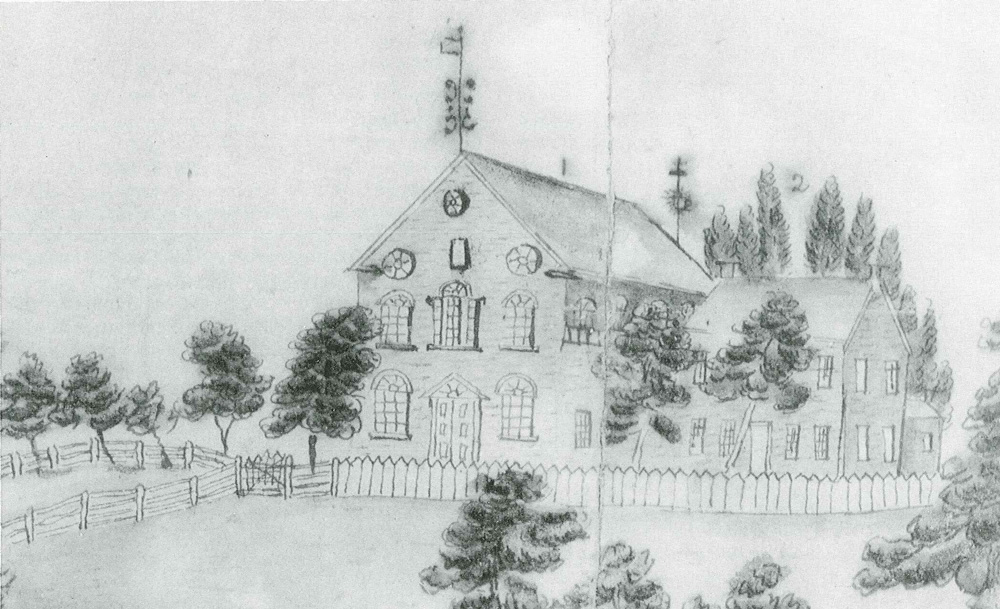
Seeing this issue, the Jesuit Priests and the parishioners of the Chapel worked together to have built a new Church. This Church was started in 1785 and finished (dates vary) between 4 February to 9 February 1787. When it was dedicated it was given the name Church of the Sacred Heart. This would be the “first parish church in the Western Hemisphere bearing this title.” (2) Again, officially was called Church of the Sacred Heart, but most of the parish just called it the Conewago Chapel.
Apostle of the Alleghenies and a School

One of the most notable people that called the chapel their parish was Fr. Demetrius Gallitzin. Fr. Demetrius was a Russian Prince who converted to Roman Catholicism. During his early years into his priesthood, he spent it at the Conewago Chapel. Afterwards went to “evangelize west of the Susquehanna and founded the Catholic settlement of Loretto, Pennsylvania, where he became known as “the Apostle of the Alleghenies.” (2) In a future post this author hopes to write more about his life and journey on the Adamsist.
In and around 1834 the Sisters of Charity were invited to travel from Emmitsburg, Maryland to Conewago Chapel to start the parish school which the school stayed open until 2017.
Enlarging the Church
In 1850 and 1851 the Church was consecrated Bishop Francis P Kenrick, who was the Bishop of Philadelphia. From what is gathered the 1851 consecration was done after the Church had been enlarged to have added of a transept and the apse. Then in 1873 the steeple was added.
The 20th Century to Present
On 3 June 1901, the Jesuit Order withdrew their charge of caring for the Church. It was then the local bishop, Rev. John W. Shanahan appointed the first diocesan priest as pastor of Conewago Chapel.
On 11 July 1962 Pope St. John XXIII announced in a Papal Bull that the Conewago Chapel would be raised to the honor and dignity of a Minor Basilica. In a document written on 30 June 1962 John XXII stated, “Blessed in the sight of heaven is the place called Conewago, famous, above all else, as the seat of the first church in the United States, and perhaps in all North America, dedicated to the Sacred Heart of Jesus, and as a cradle of fervent Catholic Life. The church is counted among the fairest of the land. The faithful of America to this shrine of religion to share in the sacred rites and to ‘drink deep from the foundation of salvation.’ (Is 12:3).” (2)
As of 2021 the Church of the Sacred Heart known as the Conewago Chapel is still an active parish in the Diocese of Harrisburg. Sometime between 1962 until now the Church was registered as a Historic Site by the National Historic Sites.
Conclusion

For over two hundred years this parish has served the Catholic community. What it started as a chapel for those being exiled and oppressed because they were Catholics to now a Minor Basilica. In 1937 Bishop George L. Leech said this about the Church, “Conewago belongs to America, not merely to a parish or a diocese because it was the gateway through which passed the saintly founders and zealous missionaries who carried the light of the true faith eastward and westward into the frontiers of our land, long generations before the found of our beloved nation.” (2)
Resources
Burch, Brian and Emily Stimpson. The American Catholic Almanac. Crown Publishing Group. New York, New York. 2014.
Woodstock Letters, Volume XXI, Number 2, 1 June 1892-Church of the Sacred Heart. Historically Known As Conewago Chapel. (Letter): Jesuit Online Library

